
Total Project Management Framework
Home

Framework

  • Framework overviewTotal Project Management Framework
  • TPM Lifecycle MapOne system, from the whole project to each method
    • Project Steps
    • Tool Levels

TPM platform

  • AI Project AdministratorFlagship feature of the TPM platform

Approach

  • Human-in-the-Thought-Loop Paradigm
  • Human-in-the-Thought-Loop Manifesto
  • Research & Evidence
Map the work.See the whole project and choose your next step.

Learning

  • Learning with TPM
  • All courses
  • Become an instructor

Course categories

  • Marketing and Sales
  • Finance and Investment
  • Project Management
  • Art and Design
  • IT and Programming
  • Personality Development

Instructors

  • Our instructors
  • Claudia Martínez
  • Emily Johnson
  • May Soon
  • Mirko Vuchkovich
  • Oleksandr Ivanov
  • Ryan Smith
Back to schoolImprove your skills every day – learn from industry leaders!

Learn and Work!

  • Log In
  • Membership Levels
Learn and Work!Improve your skills every day – learn from industry leaders!

Blog

  • All articles
  • Marketing and Sales
  • Finance and Investment
  • Project Management
  • Art and Design
  • Personality Development

Events

  • All eventsWorkshops and conversations
  • Share your expertiseExplore becoming an instructor
Bring your experienceArticles, events and people of the TPM community.
  • About TPMThe system, founder and team
  • Founder
  • Training cases
  • Team
  • Contact TPM
People behind TPMFounder, team and educational practice.
  • English
  • Русский
  • Українська
    • TPM header AI layout (CSS)

    • TPM shared footer navigation

    Home
    System

    Framework

    • Framework overviewTotal Project Management Framework
    • TPM Lifecycle MapOne system, from the whole project to each method
      • Project Steps
      • Tool Levels

    TPM platform

    • AI Project AdministratorFlagship feature of the TPM platform

    Approach

    • Human-in-the-Thought-Loop Paradigm
    • Human-in-the-Thought-Loop Manifesto
    • Research & Evidence
    Learning

    Learning

    • Learning with TPM
    • All courses
    • Become an instructor

    Course categories

    • Marketing and Sales
    • Finance and Investment
    • Project Management
    • Art and Design
    • IT and Programming
    • Personality Development

    Instructors

    • Our instructors
    • Claudia Martínez
    • Emily Johnson
    • May Soon
    • Mirko Vuchkovich
    • Oleksandr Ivanov
    • Ryan Smith
    Learn and Work!

    Learn and Work!

    • Log In
    • Membership Levels
    Community

    Blog

    • All articles
    • Marketing and Sales
    • Finance and Investment
    • Project Management
    • Art and Design
    • Personality Development

    Events

    • All eventsWorkshops and conversations
    • Share your expertiseExplore becoming an instructor
    About
    • About TPMThe system, founder and team
    • Founder
    • Training cases
    • Team
    • Contact TPM

    Practitioner

    7
    • Create and find your first TPM project
    • Use the step workspace, article and AI panels
    • Work with the AI Project Administrator
    • Find courses and follow your learning
    • Understand membership, AI access and course access
    • Find your way around My workspace
    • Resolve common navigation and access problems

    Instructor

    5
    • Open the Instructor Panel and prepare a course
    • Build a course curriculum
    • Set course assessment and completion rules
    • Set course duration and downloadable materials
    • Set a course price and review publication
    Help Centre
    Instructor

    Open the Instructor Panel and prepare a course

    ← All help topics · Instructor

    English · Русский · Українська

    Start with a course draft and review its description, curriculum and access settings before publication.

    Instructions for:Choose Desktop or Mobile. Both versions are available below when JavaScript is disabled.

    On desktop #

    1. Open My workspace → My Teaching → Instructor Panel.
    2. Choose Courses, then Create Course.
    3. Enter a clear course title in Overview. Set the course to Draft while preparing it.
    4. Write a description that explains the intended learner, the problem addressed, prerequisites and what the learner will practise.
    5. Add the featured image, category and tags that fit the course. Follow the file-type and size limits displayed by the upload field.
    6. Save the course before adding curriculum sections. The editor explicitly asks for this before it can add a section.

    On mobile #

    Use a desktop browser for course authoring while the mobile editing controls remain limited. Select Desktop above to read the editing instructions and watch the recording.

    Use the three editing areas #

    • Overview: title, description, image and classification.
    • Curriculum: sections containing lessons, quizzes and assignments.
    • Settings: duration, price, assessment and other course rules.

    The panel’s main navigation also provides Lessons, Quizzes and Questions. Use the course curriculum to check how those items are arranged for this course.

    If you do not see My Teaching #

    The help’s Instructor switch does not grant instructor permissions. See Become an instructor for the entry route. If you expect author access but the panel is missing, contact support with your account and the course you need to manage.

    Review the learner-facing page #

    Use Preview to review the course page. Check the language, image, title and summary as well as the curriculum. Save your intended changes and verify them again. Publication controls depend on your permissions and any review process applying to your account.

    Plan a focused practice course #

    From Idea to Pilot: A Coffee Kiosk Case uses one fictional situation throughout. The first lesson frames the commuter problem; the second designs a measurable pilot. A two-question knowledge check asks learners to distinguish observations from assumptions and choose evidence for an expansion decision.

    Describe the intended outcome, prerequisites and expected study time before building the activities. This example takes about 30 minutes and asks for a short decision brief. Give every activity a meaningful title; use realistic paragraphs rather than placeholder words.
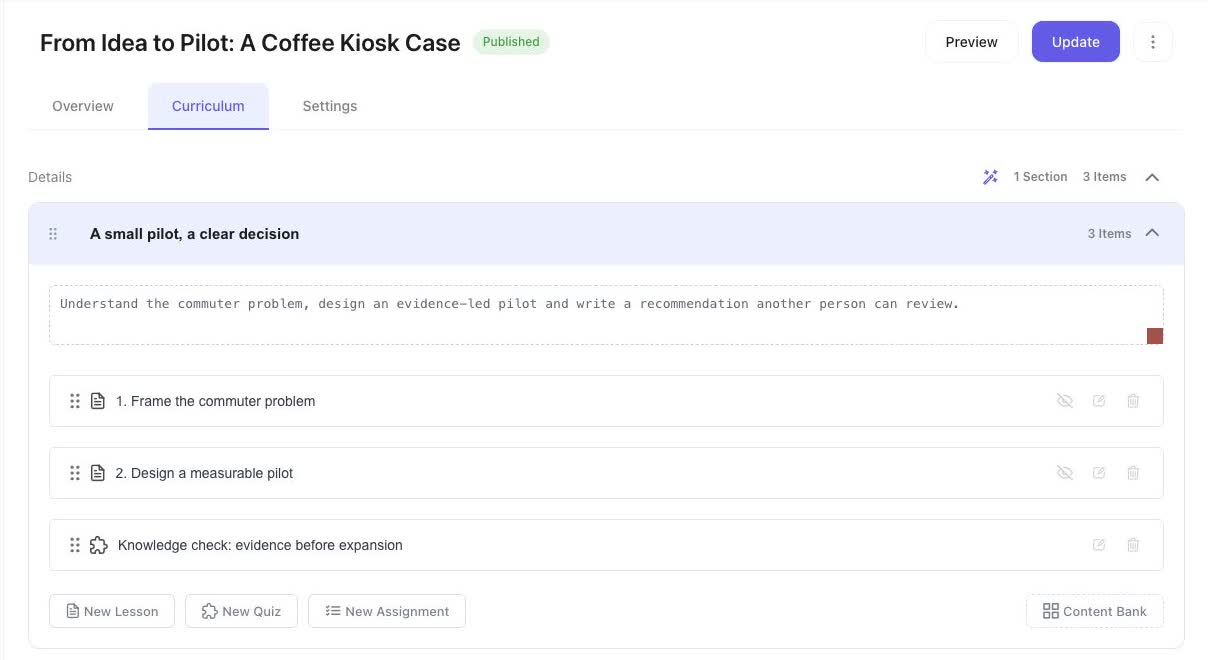
    Coffee pilot course with two lessons and a knowledge check
    A clear section title, a short purpose statement and three named activities help learners understand the sequence.

    Find a course shared with you as co-instructor #

    A co-instructor contributes to a course owned by another instructor. The owner and co-instructor are separate assignments; becoming a co-instructor does not transfer course ownership.

    1. Ask the course administrator to add your instructor account to the course.
    2. Open My workspace and expand My Teaching.
    3. Choose Co-Instructor. Find the shared course and check its title and displayed owner.
    4. Select the course card to review its public course page.
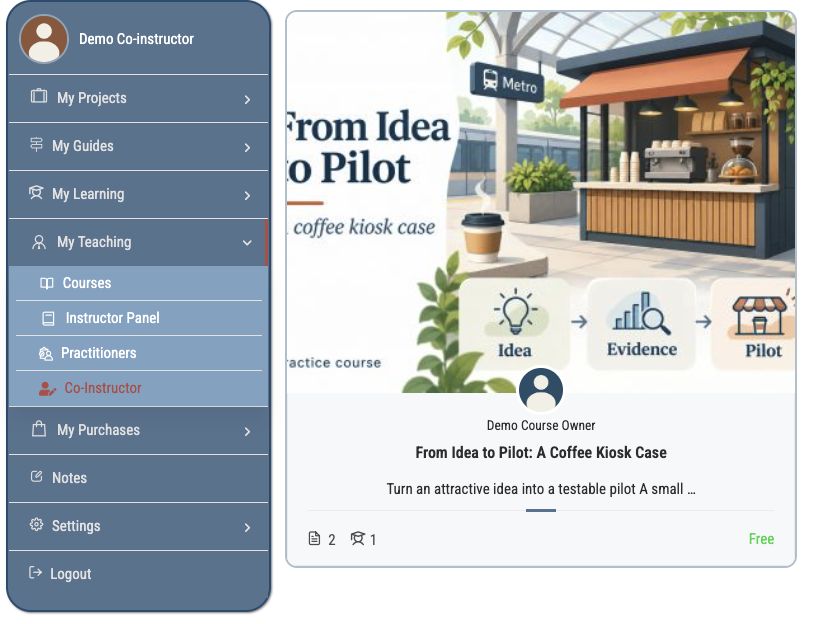
    My Teaching with Co-Instructor selected and the shared Coffee Kiosk course showing a different owner
    The example uses two distinct demo identities: Demo Co-instructor and Demo Course Owner. Select the image to enlarge it.

    For course administrators: assign the contributor #

    1. In WordPress, open LearnPress → Courses and edit the intended course.
    2. Open Course Settings → Author. Confirm the existing course author.
    3. In Co-Instructors, select the intended instructor account. Keep the author unchanged when you only want to add a contributor.
    4. Update the course, reopen these settings and check that the assignment remains saved.
    5. Ask the contributor to check My Teaching → Co-Instructor under their own account.

    The selector offers instructor and administrator accounts. A practitioner account needs the appropriate instructor role before it can be selected.

    Current limitation: a shared course can appear under Co-Instructor while being absent from the editor’s Courses list. If that happens, contact the course administrator. Do not create a duplicate course. The complete editor navigation walkthrough will be added after this issue is corrected.

    Interface reviewed on 12 November 2026. Screens shown are from the development environment.

    Next guideBuild a course curriculum
    What are your Feelings

    Share This Article :

    • Facebook
    • X
    • LinkedIn
    • Pinterest
    Still stuck? How can we help?

    How can we help?

    Updated on 13.11.2026
    0%
    Table of Contents
    • On desktop
    • On mobile
    • Use the three editing areas
    • If you do not see My Teaching
    • Review the learner-facing page
    • Plan a focused practice course
    • Find a course shared with you as co-instructor

    More help

    • Build a course curriculum
    • Set course assessment and completion rules
    • Set course duration and downloadable materials
    • Set a course price and review publication
    Total Project Management Framework

    Map the work. Run the steps. Own the decision.

    Framework

    Framework overviewTPM Lifecycle Map
    • Project Steps
    • Tool Levels

    Approach

    ParadigmManifestoResearch & Evidence

    Learning

    Learning with TPMAll coursesOur instructorsBecome an instructor

    Community

    BlogEvents

    About

    About TPMFounderTraining casesTeam

    Workspace & help

    My workspaceMy membershipMembership levelsGetting started
    EnglishРусскийУкраїнська
    Public offerPrivacy+380 98 019 07 89[email protected]

    Login with your site account

    Lost your password?

    Not a member yet? Register now

    Register a new account

    Are you a member? Login now