
Back

Choose and Approve Research Methods

Topic Definitions #

Structure of Modern Marketing Analysis #

Environment

Customer

Market

Strategy

Section 1. Macro Factors Analysis
Picture of Purpose:

Purpose:

  • Understand the environment in which the project will operate.
  • This stage identifies long-term trends and external forces that cannot be controlled but must be taken into account.
Picture of Key tasks:

Key tasks:

  • Scan the political, economic, social, technological, environmental, and legal contexts (PESTEL).
  • Identify drivers and barriers that may reshape the market.
  • Model development scenarios and assess their sensitivity for the project.

Tools and methods:

  • PESTEL Analysis #

    a basic framework for analyzing the external environment.

  • Scenario Trend Scan (STEEP/DESTEP) #

    identification of long-term trends and early signals.

  • Cross-Impact Assessment #

    evaluation of how factors interact (e.g., how technological progress affects legislation).

  • Sensitivity Mapping #

    visualization of which scenarios are most risky or promising.
Picture of Outputs:

Outputs:

  • A map of external factors and trends.
  • Scenarios with probability assessment.
  • A list of opportunities and threats (O/T) for integration into SWOT.
Section 2. Customers’ Needs & Unique Selling Proposition
Picture of Purpose:

Purpose:

  • To develop an understanding of customers’ real needs and determine what makes the future product unique.
  • If the first step described “the world around,” this one describes “the customer’s world.”
Picture of Key tasks:

Key tasks:

  • Understand who the customers are and what matters to them.
  • Identify the points where customer tasks overlap with product functions.
  • Examine the emotional and cultural context of customer perception.

Tools and methods:

  • Segmentation & Personas #

    identifying customer groups based on demographic, behavioral, and psychographic characteristics.

  • JTBD (Jobs To Be Done) #

    analyzing the context in which the customer “hires” the product to accomplish a task.

  • Customer Journey Map (CJM) #

    visualizing the customer’s path from need awareness to post-purchase experience.

  • Value Proposition Canvas (VPC) → USP #

    aligning customer pains and product value into a cohesive offering.

  • Vibe & Cultural Factors #

    emotional codes, cultural markers, and references that shape the brand’s “atmosphere.”

Picture of Outputs:

Outputs:

  • Personas, JTBD maps, and a VPC with a validated Unique Selling Proposition (USP).
  • Strengths and weaknesses of the product’s value (S/W for SWOT).
Section 3. Competitive Analysis & OSINT
Picture of Purpose:

Purpose:

  • To define the market structure, the intensity of competition, and determine the project’s real position among other players.
  • This is the moment of transition from an internal perspective (us and the customer) to an external one (the market and competitors).
  • Picture of Key tasks:

    Key tasks:

    • Build a map of market forces.
    • Identify who dominates, who is growing, and who is losing ground.
    • Reveal actual competitive differentiation.

    Tools and methods:

    • Micro-environment Mapping #

      mapping suppliers, partners, customers, substitutes, and competitors.

    • Competitive Map (Value–Price or Feature–Benefit) #

      visual comparison of players’ positions.

    • Porter’s Five Forces #

      pressure from suppliers, customers, substitutes, new entrants, and the level of intra-industry rivalry.

    • Extended Data-Driven SWOT Analysis: #

      deep SWOT with digital metrics and data analytics.

    • CSF (Critical Success Factors) #

      key success criteria in the market.

    • CPM (Competitive Profile Matrix) #

      comparing us and competitors across CSFs.

    • Competitive Polygon #

      visualization of strengths and weaknesses.

    • Integration of O/T #

      adding external factors from PESTEL.

    • Strategic SWOT Matrix (Analytical) #

      generating S–O, S–T, W–O, and W–T hypotheses.

    • Benchmarking & AI Analytics #

      analysis of digital data, trends, reviews, and attribution (MMM, neural attribution, sentiment AI).

    Picture of Outputs:

    Outputs:

    • A map of the competitive landscape.
    • Validated CSFs and SWOT hypotheses.
    • Analytical hypotheses for strategic decision-making.
    Section 4. Formulate Competitive Marketing Strategy
    Picture of Purpose:

    Purpose:

  • To integrate everything obtained into a single vector of action — a strategy that defines how the project will win the market and grow.
  • This is the bridge between analysis and practical management.
  • Picture of Key tasks:

    Key tasks:

    • Translate SWOT hypotheses into strategic decisions.
    • Formulate goals, positioning, and growth approaches.
    • Build a system for measuring and managing growth.

    Tools and methods:

    • Interpret Strategic SWOT Hypotheses → Strategic Goals #

      prioritizing hypotheses and setting measurable objectives.

    • Mission & Vision #

      defining the long-term purpose and the desired future state.

    • STP (Segmentation → Targeting → Positioning) #

      selecting target segments and building positioning.

    • Growth Strategy (Ansoff Matrix) #

      choosing growth scenarios: market penetration, product development, market development, diversification.

    • Growth Marketing System* #

      a systematic growth cycle: hypothesis creation, A/B tests, iterations, analytics.

    • Growth Hacking #

      a growth accelerator: short, low-cost experiments with high viral potential (referral loops, viral loops, product triggers, behavioral nudges).

    • Branding & Vibe Positioning #

      emotional brand identity, cultural code, product atmosphere.

    • Ethical & Sustainable Marketing #

      incorporating transparency, sustainability, and trust principles.

    • AI-Driven Measurement & Risk Framework #

      data-driven management: KPIs, automated attribution, W–T risk modeling from SWOT.

    Difference Between Growth Marketing and Growth Hacking:

    Growth Marketing

    is a systematic growth process. where hypotheses, experiments, and A/B tests are built into a continuous cycle. It is part of the strategic block, forming a sustainable growth-management system.

    Growth Hacking

    is an experimental growth accelerator with minimal resources: testing hypotheses through unconventional, rapidly deployable tools. It is a “tactical booster” embedded within Growth Marketing as a specialized toolkit.

    Picture of Outputs:

    Outputs:

    • Strategic Passport — a consolidated map of goals, segments, and approaches.
    • Growth Map — a visual map of growth initiatives and experiments.
    • KPI & Risk Dashboard — a panel of metrics and risk indicators.

    Structure of Modern Marketing Analysis #

    1. СHAPTER 1 → Macro Factors → Opportunities & Threats (SWOT O/T)
    2. СHAPTER 2 → Customers & USP → Strengths & Weaknesses (SWOT S/W)
    3. СHAPTER 3 → SWOT + Strategic Matrix → Strategic Hypotheses
    4. СHAPTER 4 → Interpret SWOT Hypotheses → Strategy → KPIs → Execution

    Decision Framework #

    Purpose

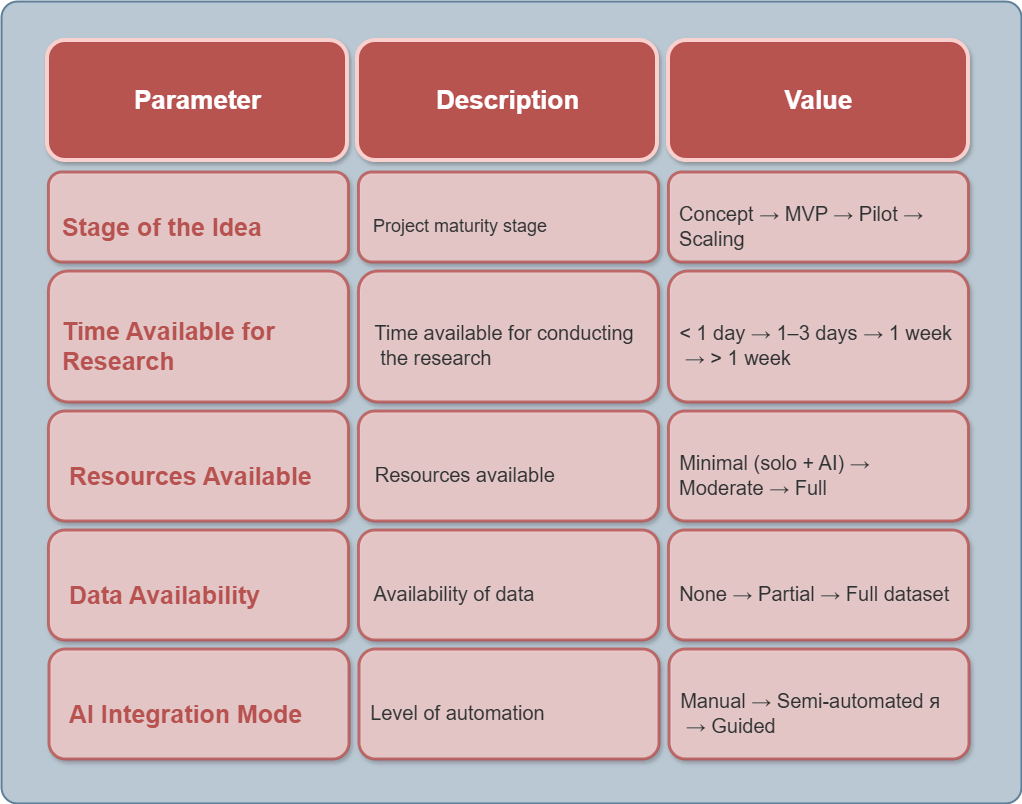
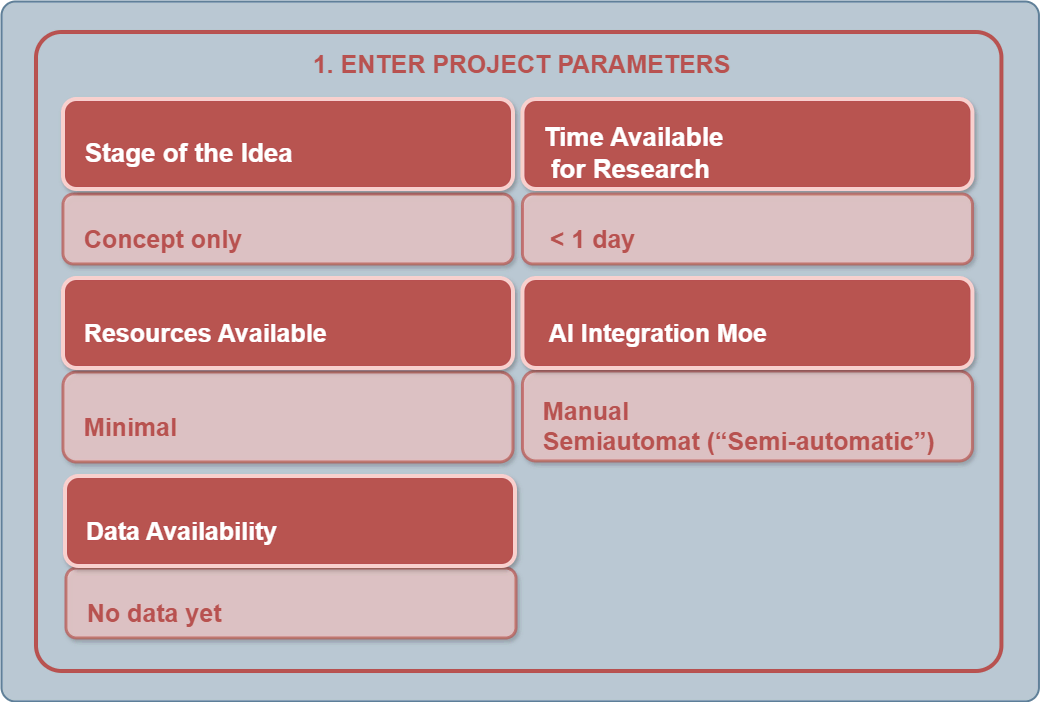
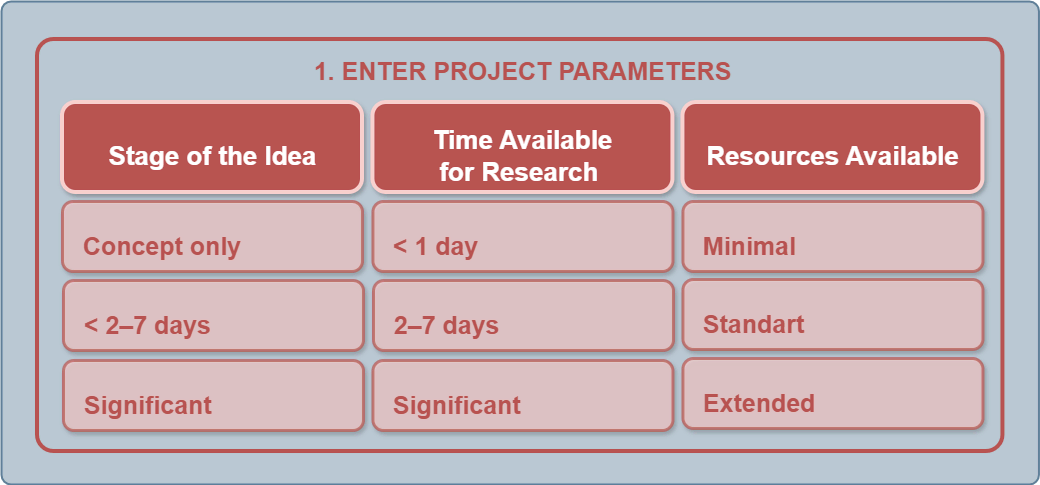
    Step 1 — Define Research Parameters

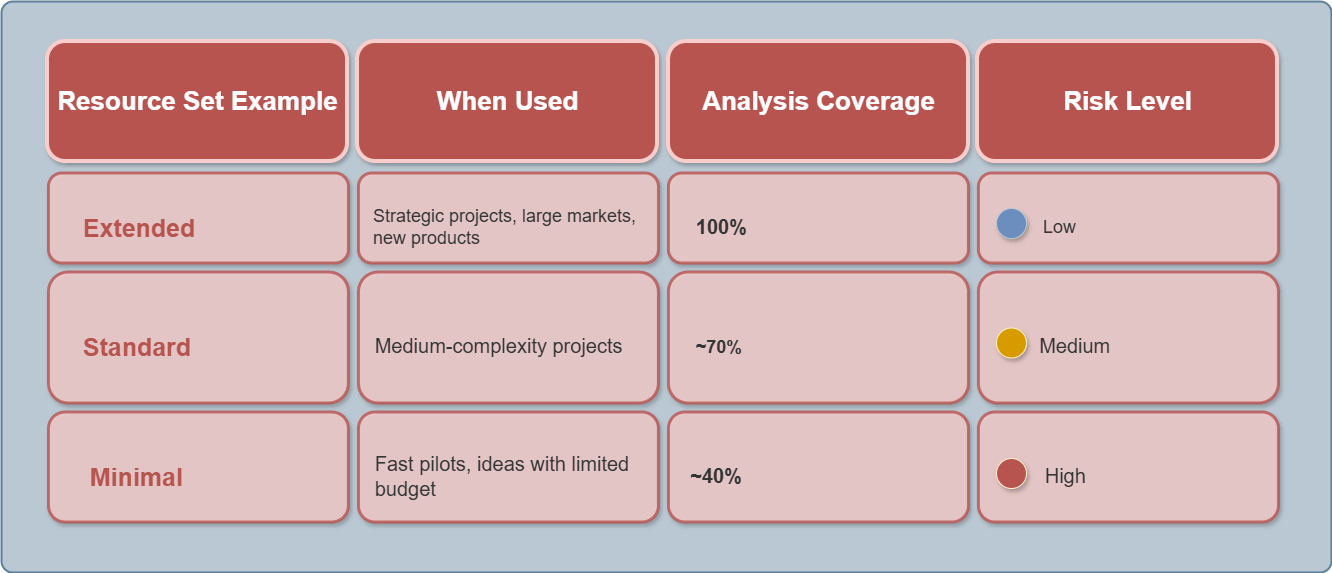
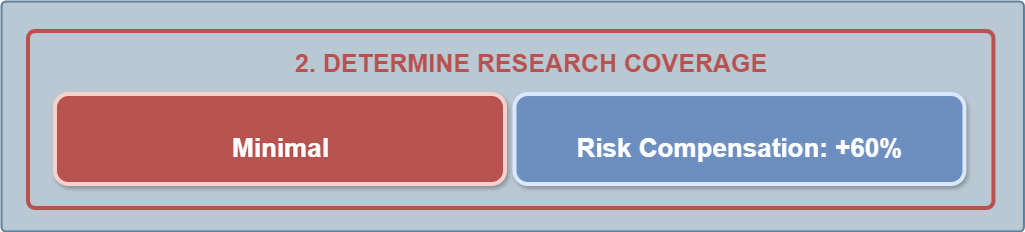
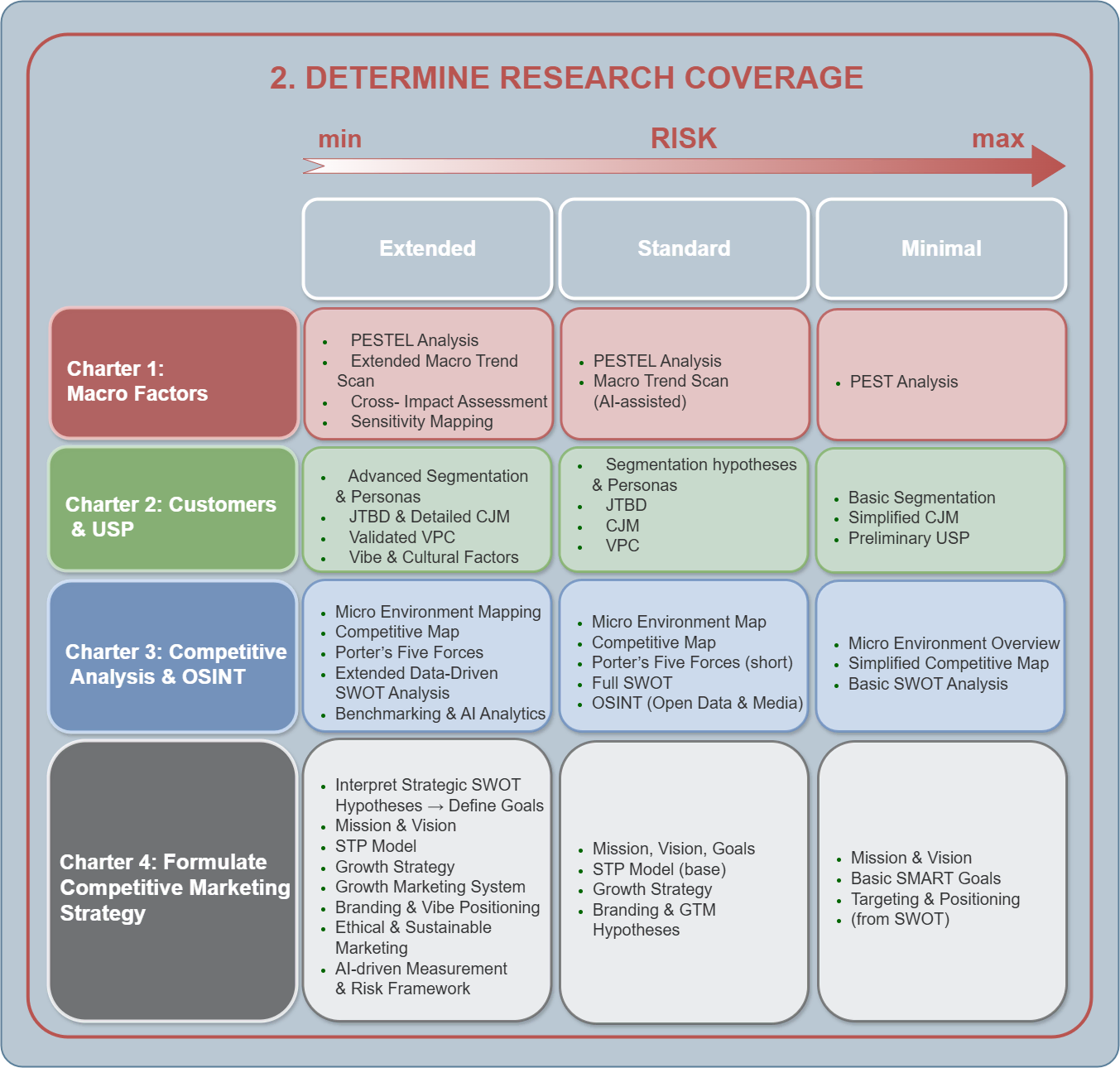
    Step 2 — Determine Research Coverage

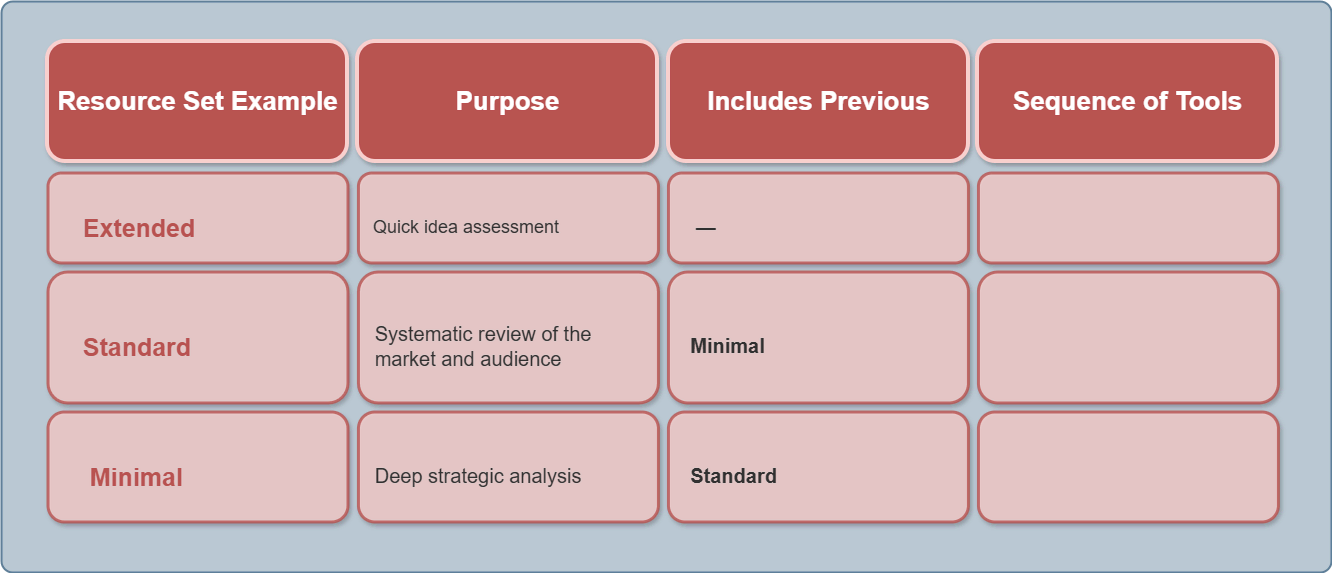
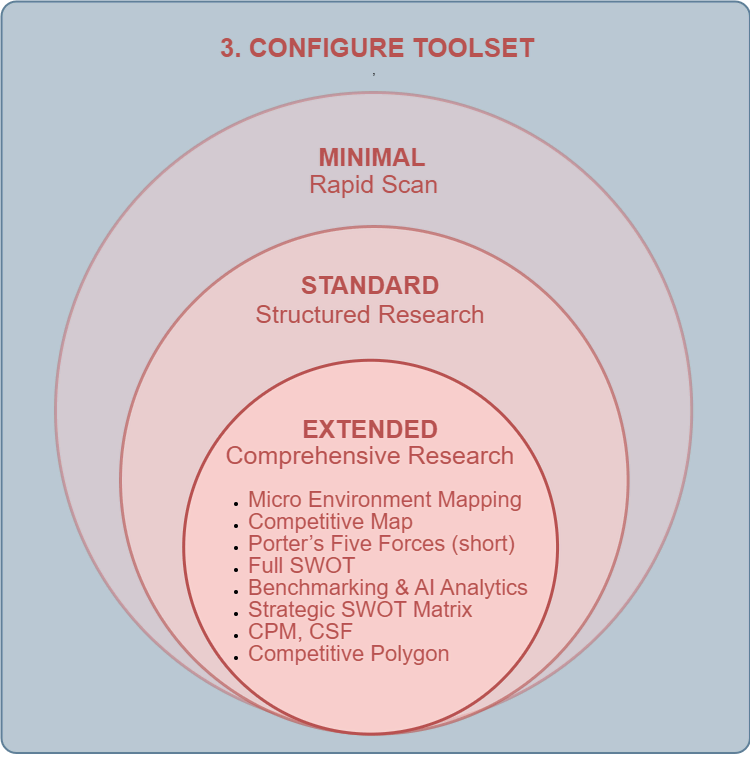
    Step 3 — Configure Toolset

    Charter 1. Macro Factors Analysis

    Picture of Purpose:

    Purpose:

    • Identify global trends and factors that shape the project’s market context.
    • PESTEL Analysis

      a full examination of political, economic, social, technological, environmental, and legal factors.

    • Extended Macro Trend Scan

      scenario-based trend modeling (STEEP/DESTEP), detection of early signals.

    • Cross-Impact Assessment

      analyzing interdependencies between trends (e.g., Tech–Legal, Eco–Social).

    • Sensitivity Mapping

      assessing how sensitive the project is to different scenarios.

    Picture of Outputs:

    Outputs:

    • Scenario Maps
    • Sensitivity Matrix
    • AI Dashboard
    • PESTEL Analysis (short)

      key macro factors.

    • Macro Trend Scan (AI-assisted)

      major drivers and barriers.

    Picture of Outputs:

    Outputs:

    • PESTEL Summary
    • Trend–Impact Table
    • PEST Analysis

      political, economic, social, and technological factors.

    Picture of Outputs:

    Outputs:

    • PESTEL Summary
    • Trend–Impact Table

    Charter 2. Customers’ Needs & Unique Selling Proposition

    Picture of Purpose:

    Purpose:

  • Understand the real motivations of users and define the value core of the product.
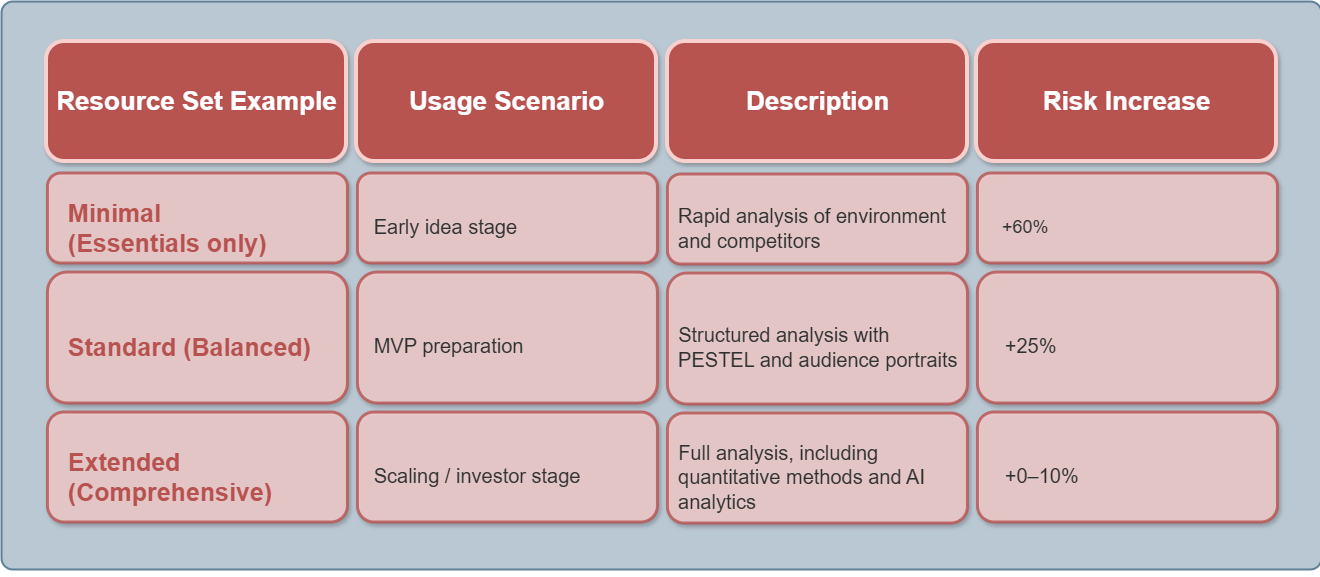
  • Extended Resource Set:
    • Advanced Segmentation & Personas

    • JTBD (Jobs-To-Be-Done) & Detailed CJM

    • Validated Value Proposition Canvas (VPC) — data-driven validation of value propositions

    • Vibe & Cultural Factors — emotional and cultural perception of the brand

    Picture of Outputs:

    Outputs:

    • Persona Portfolio, JTBD Map, Enhanced USP Model.
    Standard Resource Set:
    • Segmentation Hypotheses & Personas
    • JTBD (base version)
    • CJM (Customer Journey Map)
    • Value Proposition Canvas (VPC)
    Picture of Outputs:

    Outputs:

    • JTBD + CJM + VPC + Draft USP
    Minimal Resource Set:
    • Basic Segmentation
    • Simplified CJM
    • Preliminary USP
    Picture of Outputs:

    Outputs:

    • CJM Sketch, USP Draft

    Charter 3. Competitive Analysis & OSINT

    Picture of Purpose:

    Purpose:

  • Determine the market structure, competition intensity, and the project’s strengths and weaknesses.
  • Extended Resource Set:

    Extended Resource Set:

    • Micro Environment Mapping — mapping the market actors

    • Competitive Map (Value–Price) — positioning

    • Porter’s Five Forces — pressure from suppliers, customers, substitutes, and new entrants

    • Extended Data-Driven SWOT Analysis:

      • Identify Critical Success Factors (CSF)

      • Build a Competitive Profile Matrix (CPM)

      • Visualize a Competitive Polygon

      • Integrate Opportunities/Threats from PESTEL

      • Strategic SWOT Matrix (Analytical) — generating S–O, S–T, W–O, W–T hypotheses

    • Benchmarking & AI Analytics (Sentiment, MMM, Attribution)

    Picture of Outputs:

    Outputs:

    • CSF, CPM, Competitive Polygon, Strategic SWOT Hypotheses
    Standard Resource Set:
    • Micro Environment Map
    • Competitive Map
    • Porter’s Five Forces (short)
    • Full SWOT
    • OSINT (Open Data & Media)
    Picture of Outputs:

    Outputs:

    • SWOT Matrix, Porter Summary, OSINT Snapshot
    Minimal Resource Set:
    • Micro Environment Overview

    • Simplified Competitive Map

    • Basic SWOT Analysis

    Picture of Outputs:

    Outputs:

    • Express SWOT Summary

    Charter 4. Formulate Competitive Marketing Strategy

    Picture of Purpose:

    Purpose:

  • Synthesize the analysis results into a strategic marketing and growth plan.
  • Extended Resource Set:
    • Interpret Strategic SWOT Hypotheses → Define Goals

    • Mission & Vision

    • STP Model (Segmentation–Targeting–Positioning)

    • Growth Strategy (Ansoff Matrix)

    • Growth Marketing System — experiments, A/B tests, hypothesis cycles

    • Branding & Vibe Positioning

    • Ethical & Sustainable Marketing

    • AI-driven Measurement & Risk Framework

    Picture of Outputs:

    Outputs:

    • Strategic Passport, Growth Map, KPI & Risk Dashboard
    Standard Resource Set:
    • Mission, Vision, Goals
    • STP Model (base)
    • Growth Strategy
    • Branding & GTM Hypotheses
    Picture of Outputs:

    Outputs:

    • Strategy Document, GTM Plan
    Minimal Resource Set:
    • Mission & Vision

    • Basic Goals (SMART)

    • Targeting & Positioning (from SWOT)

    Picture of Outputs:

    Outputs:

    • One-page Strategy Summary.

    Step 4 — Resource and Time Adjustment

    • Little time

      quantitative methods are excluded, only qualitative methods remain.

    • Limited budget

      AI replaces field research with secondary data.

    • Lack of data

      AI focuses on generating and validating hypotheses.

    Step 5 — Review and Approval Workflow

    Scenarios of Use #

    Picture of 1. Startup with Limited Resources

    1. Startup with Limited Resources

  • Mode: Minimal
  • Time: 2 days
  • Result: AI performs trend analysis, builds a mini SWOT, and identifies three competitors.
  • The system warns:
    “+45% uncertainty. It is recommended to add market segmentation.”

  • Picture of 2. Corporate Pilot Project

    2. Corporate Pilot Project

  • Mode: Standard
  • AI completes the PESTEL and Customer Personas using internal data.
  • After the review, the user receives a structured report within one week.
  • Picture of 3. Scaling or Investor Stage

    3. Scaling or Investor Stage

  • Mode: Extended
  • AI performs quantitative validation, MMM, and neural-network-based attribution.
  • The user reviews the key findings and integrates them into the financial assessment.
  • Results and Benefits #

    • intentional

      risks and trade-offs are visible immediately;

    • adaptive

      coverage is adjusted based on resources;

    • intelligent

      AI handles routine work while the human approves the meaning;

    • universal

      suitable for both startups and corporate teams.

    Conclusion #

    • Research #

      is not “just another document,” but a system of interlinked steps: each stage feeds the next.

    • Strategic SWOT Matrix #

      is a bridge between analytics and strategy: we generate hypotheses at Step 3, and then interpret and prioritize them at Step 4.

    • Communications #

      are only the tip of the iceberg; the reliability of decisions depends on the quality of the underwater part — research and strategy.
    What are your feelings
    Updated on 03.12.2025